Back to the minefield! In the previous issue, I presented a map or spectrum of views on Israel, the church, and the people of God. It introduced one strategy for navigating controversial issues. For the second strategy, I will use an adaptation of a tool normally used to understand interpersonal conflict.
You can also watch this content as a VIDEO PODCAST
Value Squares
Values or virtues tend to come in pairs or groups of opposites. Think of generosity and frugality as a classic example. Both are good; they are virtues. Nevertheless, there is a certain tension between the two.

At the same time, each virtue tends to have a corresponding vice. Any virtue that is exaggerated turns into that vice. In this case, generosity becomes wastefulness, and frugality turns into greed or stinginess.

If a particular virtue is especially important to us, we become highly sensitive to the opposite vice and may even mistake the opposite virtue for that vice. This frequently plays a role in conflicts. We are quick to condemn the opposite (how wasteful! so stingy!) but slow to see how our own value has perhaps become exaggerated and is perceived by those holding the opposing view as a vice.

Fact is, we need the opposite virtue to keep our own value from sliding into vice.
A classic example of a virtue pair in politics is freedom and security or law and order. We want both! But they are in tension. More freedom comes at the expense of security and more law and order reduces the level of individual freedom. Too much freedom can lead to anarchy and chaos. Too much law and order can end in tyranny.

Doctrinal Squares
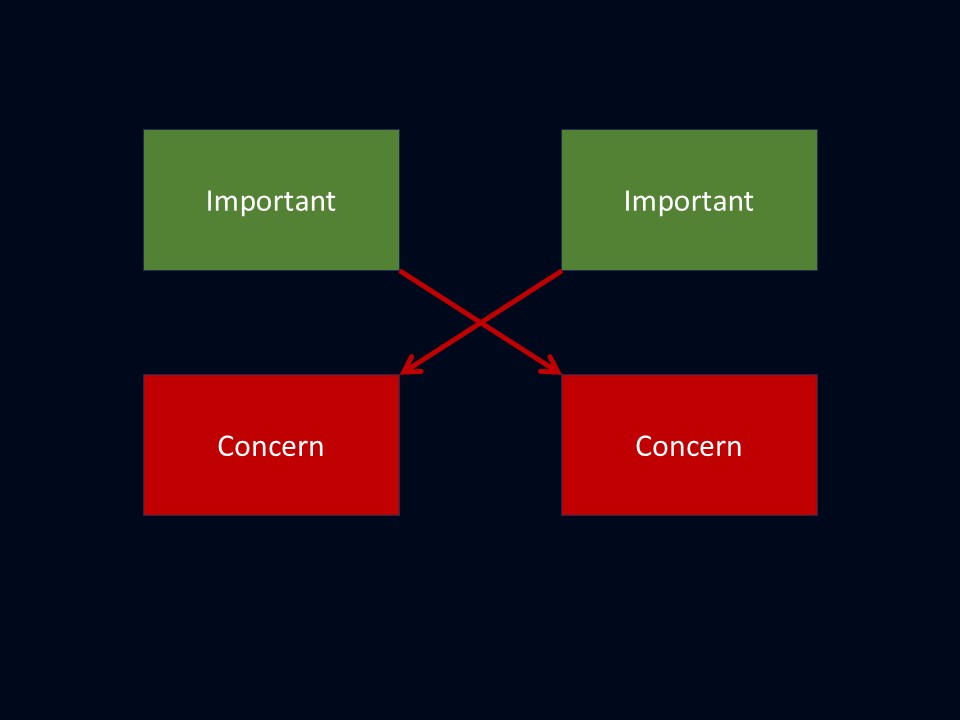
When it comes to doctrine or beliefs, we react in a similar way to opposite beliefs. Our beliefs reflect or determine what is important to us (the positive). From this flow our concerns with the alternative: It misses something essential or includes what is perceived as wrong or false (the negative).
Two examples before we return to the question of Israel. First, predestination and free will. The first position may fear that its opposite does not recognize the absolute sovereignty of God and may effectively imply he is not truly God. Free-will advocates, on the other hand, may be horrified that humans are deprived of their God-given agency and reduced to mere puppets if God’s sovereignty is emphasized.

Second, for some, the word of God is preeminent. The alternative, ‘charismatic’ position, so it may be feared, is bound to descend into disorder and worse. For their counterparts, the Holy Spirit and his gifts are preeminent, and their neglect leads to dead orthodoxy, a technically correct faith that is nevertheless devoid of life.

This is the key insight. On both sides, the dangers of the opposing view tend to be exaggerated. Yet the concerns themselves often point to something genuinely important: divine sovereignty, human freedom, and accountability; a measure of order and truth balanced by spiritual life – nothing here we can do without.
Doctrinal Pairs and Squares for Israel
With the framework in place, let’s return to our theological minefield and see what happens when we apply this tool to Israel and the people of God. I will limit the overview to Christian Zionism and Fulfilment or Expansion Theology, as discussed in the previous issue.
The People of God
Christian Zionists feel strongly that the promise to Israel must be kept, and that this implies a national Israel. If this is neglected, it leads to the view that the church has replaced Israel and to anti-Judaism.
Those supporting fulfilment or expansion feel strongly that Gentile believers have been incorporated into the people of God as full and equal members, with full citizenship and equal rights. Gentile believers share the promised inheritance. Anything less creates two classes within the people of God.

How to Read the Bible
Underlying both views is a different way of reading the Bible. Literal fulfilment means the land and the nation of Israel still have a role or at the very least a place in God’s unfolding plan. The other side is perceived as spiritualizing and allegorizing the prophets, that is, looking for deeper, ‘spiritual’ meaning in the text. This – again – leads to anti-Judaism, because it must all be about the ‘spiritual’ church, not ‘natural’ Israel.
Those holding the alternative view recoil in horror. Reading the Bible this way risks treating Old Testament institutions such as temple, sacrifice, and ritual law as if Christ had not fundamentally transformed their meaning. It leads us straight back into the ritual system. It contradicts the New Testament, which is full of surprising fulfilments of Old Testament promises.

Justice and Historical Truth
When it comes to the present, Christian Zionists feel Israel is often unfairly criticized and that history is frequently distorted. We need to support Israel!
Their counterparts may also feel that history is being distorted, but in the opposite way: It is the Palestinians who are treated unjustly and need our support. Or alternatively, as Christians we should not take sides in this conflict but rather be advocates for reconciliation.

The Most Relevant Bible Passages
Lastly, back to the Scriptures: Much depends on which passages are given priority. Some readers place Romans 11 at the centre of the discussion because of its emphasis on God’s continuing commitment to Israel: “The gifts and the calling of God are irrevocable” (Rom. 11:29). Israel must retain a distinctive place in God’s purposes, they argue, although it is usually left undefined what place that is. Otherwise, the covenant is void and the promise not kept; a place or role for national Israel is vital.
Others give priority to passages such as Galatians and Ephesians, which stress the full inclusion of Gentile believers in God’s people. They enjoy full membership, and as offspring of Abraham are co-inheritors of the promise and children of God (Gal. 3 and 4; Eph. 2:12, 2:19, and 3:6).

On a Personal Note
So, how does this help me to evaluate my own convictions? My strongest concerns are with the first two doctrinal pairs: All ethnicities must be accepted as equal members in the people of God and reading the OT literally, as if Jesus and the NT don’t make a difference, does not make sense.
However, the exercise did help me to understand and validate the concerns of those holding the opposite position. Not the need for a literal reading, but the importance of a place for a national Israel. It cannot simply be discarded; in Romans 11, Paul is adamant that Israel has not been rejected and that God will have mercy on all.
So, I’d say there must be a solution that does justice to both: on the one hand, a place for Israel and Jewish people, not just as individuals, but Israel among the nations; and on the other hand, a strong emphasis that in Christ, all are equal, that is, on the same level – no ethnic or class privileges.
The Tool
The value square does not solve the debate, but it changes how we enter it. It helps to clarify and understand. Instead of asking only where the other side is wrong, it encourages us to ask what important truth they may be trying to protect. As such, it takes some of the heat out of the debate; even if I still feel I am right, it may well be that the other side is saying something important that I need to hear and consider.
By the way, the tool also really helps in interpersonal conflict situations 😊!
