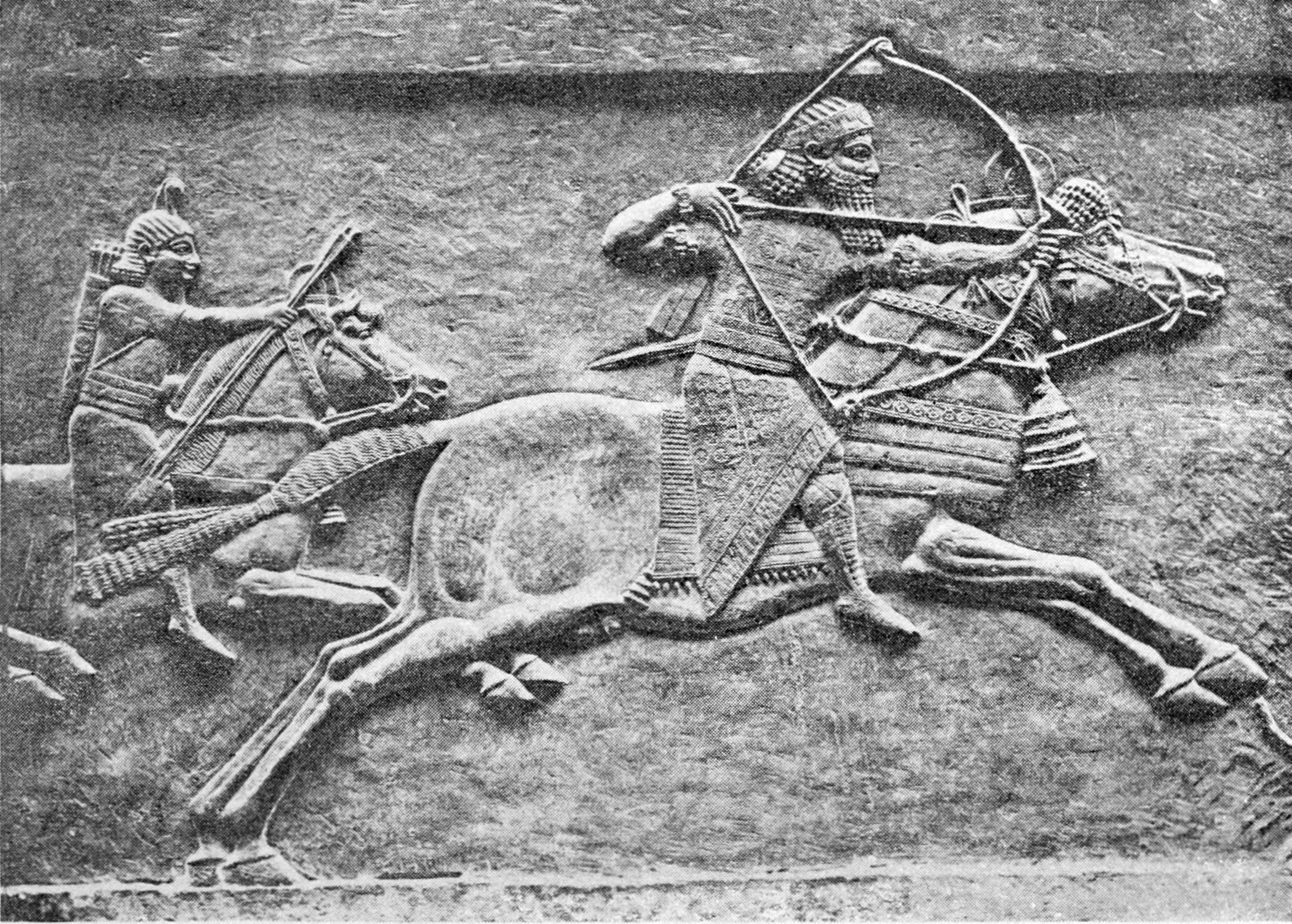
I have often spoken about Assyria, usually when teaching Isaiah or an introduction to the prophets. It is an important piece of the history underlying the Old Testament. However, this makes for a narrow focus. Reading Eckart Frahm’s book, Assyria: The Rise and Fall of the World’s First Empire (2023; paid link), has brought a welcome expansion.
You can also watch this content as a VIDEO PODCAST
The book is surprisingly readable, and I found it tremendously enjoyable. For the most part, it did not change the facts as I had known them before, but it certainly added depth. It put flesh on the mere bones of those facts. For one, the Assyrian kings who play a role in the Hebrew Bible had, not surprisingly, a life and personality beyond what we read in the Bible and what we need to understand what is written there. Something similar applies to Assyria itself: There is much more to it than the essentials for understanding the biblical narrative.
Let’s start with the early days of Assyria.
From Ashur to Assyria to Empire
By the time the Assyrians began to impinge on the biblical story, they already had a long history behind them. It all began with Ashur, shortly before 2000 BC. Ashur was both a city and its god. Or perhaps one should say, Ashur was both a god and its city; that is probably how the Assyrians would have put it. Originally, it was a city of merchants, not of conquerors – a city state, no more. It would be a long road to empire, with many setbacks. Though it began as a city of traders, Ashur would change dramatically over the coming centuries. Eventually,
as in the case of Rome, the final outcome was that Assyria morphed into a war-prone, multiethnic conqueror-state, organized into numerous provinces and geared toward moving resources on a massive scale from the periphery to the political center. In other words, Assyria grew into an empire. (Ibid., 23f).
It is common to distinguish three phases in the history of Assyria: the Old Assyrian period (ca. 2000-ca. 1700 BC), the Middle Assyrian period (1363-935 BC), and the Neo- Assyrian period (935-612 BC). Each period came with far-reaching change, that gradually transformed Assyria into a great power.
The Old Assyrian Period (ca. 2000-ca. 1700 BC) and Transition
The first phase is characterized by the trading network of the city of Ashur. Its merchants were active in substantial parts of Anatolia and Mesopotamia.
There followed a long period of transition about which we are less informed. During this time, Ashur became a monarchy and a larger territory or country, Assyria, but did not yet morph into an empire. It did become more aggressive and war prone.

The Middle Assyrian Period (1363-935 BC)
The Middle Assyrian period lasted from 1363-935 BC. From this time onward, Assyria felt led by a divine mandate to expand its land (ibid., 67). To do so was not merely expedient, it was a religious duty, a god-given mission. For the first time Assyrian kings began to use titles like “king of the world” (ibid., 69). We also read about the first deportation, a practice that would become a defining feature of the empire to come.
The second half of the Middle Assyrian period was a time of wide-spread crisis in the eastern Mediterranean (the so-called Late Bronze Age collapse), also impacting Assyria. The kingdom survived; in 935 BC the Neo-Assyrian period began:
A number of energetic and ruthless Assyrian rulers of the Neo-Assyrian period (ca. 934-612 BCE) took advantage of the weakness of their political rivals, embarking on a systematic campaign of subjugation, destruction, and annexation. Their efforts, initially aimed at the reconquest of areas that had been under Assyrian rule before and then moving farther afield, were carried out with unsparing and often violent determination, cruelly epitomized in an aphoristic statement found in another of Esarhaddon’s inscriptions: “Before me, cities, behind me, ruins.” (Ibid., 3)
The Neo-Assyrian Period (935-612 BC)
The Neo-Assyrian period (935-612 BC) lasted until the fall of the empire. This is the Assyria we know:
It was only now, in the ninth century BCE, that many of the features that would define Assyria for the rest of its history came into being: royal cities so massive that they dwarfed all previous urban foundations, monumental art in the form of bull and lion colossi and reliefs lining the walls of palaces, and a relentless cycle of annual military campaigns. (Ibid., 83f)
These reliefs vividly illustrate Assyrian aggression and cruelty. In the king’s own words (Ashurnasirpal II, 883-859 BC):

I am king, I am lord, I am praiseworthy, I am exalted, I am important, I am magnificent, I am foremost, I am a hero, I am a warrior, I am a lion, and I am a man … I captured many troops alive. From some I cut off their arms and hands; from others I cut off their noses, ears, and extremities. I gouged out the eyes of many troops. I hung their heads on trees around the city. I burned many of their adolescent boys and girls. I razed, destroyed, burned, and consumed the city. (Ibid., 102)
As for the reliefs, I had always thought that the Assyrians decorated their palaces in this way to intimidate. Representatives of vassal states had to bring their tribute in person, into the palace. They would witness the might of Assyria and the consequences of rebellion. This may well be true, but Frahm poses a different purpose: These inscriptions and illustrations were meant to inculcate the values and ideology of the empire, primarily to indoctrinate succeeding generations of Assyrian leaders.
It was only in this period that Assyrian influence directly impacted Israel. First armed contact took place during the Battle of Qarqar in 853 BC. Later, King Jehu of Israel (2. Ki. 9f) paid tribute to Assyria, as famously portrayed on the Black Obelisk (see illustration).
A time of instability in Assyria brought respite (ibid., 112ff), leading to a second golden age for Israel and Judah under Uzziah and Jeroboam II (2 Kings 14:22-15:7; 2 Chr. 26). However, once Tiglath-Pileser III took the throne (745-727 BC), Assyrian expansion was relentless – except for certain events in the year 701 BC, when then-king Sennacherib (705-681 BC) lost an entire army in Judah, as least as remembered in the Bible (Frahm considers this account historical fiction; ibid., 391).


Was Assyria First?
Did this indeed make Assyria the world’s first empire, as Frahm argues? What about Nimrod’s kingdom (Gen. 10:8-12), the Egyptians, and the Hittites?
It all depends, of course, on your definition. If it is essential to an empire to be a multiethnic conglomerate of territories, some of which are ruled by local elites, the way the Herod dynasty did for the Romans, then the thesis makes sense: Assyria was the first empire. Whether we agree or not, Assyria certainly took things to a new level. Perhaps it was the first. Others, beginning with Babylon, would follow in its footsteps. At the same time, the Assyrian Empire exemplifies a human drive that has been in evidence from very early on (again, Nimrod): the desire to control and exploit others.
Sargon II (722-705 BC)
Here is an interesting titbit of information (one among many in Frahm’s book) that helps explain Isaiah 14, a remarkable description of the Babylonian king descending into the realm of the dead. It is a sarcastic lamentation, a funeral song ridiculing the demise of the proud king, “the man who made the earth tremble, … who made the world like a desert” (Is. 14:16f). Now, he is fallen from heaven and cut down to the ground (Is. 14:12; nothing suggests this is about Satan, much less about his original fall from grace; it is the description of a human and his demise). The king is “cast out, away from [his] grave” – no tomb or burial for him (Is. 14:18-20)!
But which king of Babylon can this be? There were not many, and none of those few suffered such a fate. However, here is what happened to Sargon II (722-705 BC).
Sargon II had been a strong and effective ruler, successfully conducting numerous campaigns (including one in the territory of the Philistines, briefly mentioned in Is. 20:1). In 705, he took his army on yet another campaign in today’s Turkey – and did not return. Worse: His body could not be recovered, so the king could not be properly buried.
It is hard for us to understand the horror this instilled at home. From an Assyrian perspective, proper burial was crucial, and not only to honour the king:
But they also wanted to guarantee that the royal body would not be able to leave its final resting place and haunt the living. If they were not properly buried, Assyrians believed, the dead—especially if they had been abandoned on the battlefield after being killed there—would do just that: find their way back to those they had known in life and punish them with sickness, misery, or death. Numerous ritual texts against the ghosts of the dead are known, both from Assyria and from Babylonia, and if these ghosts were the spectral remains of a powerful ruler, the dangers for the living were, of course, particularly great. (Ibid., 180)
It was also believed that the unburied dead had no one to provide food offerings and were therefore doomed to roam around, starving and in search of any scrape of food they could find.
What we need to recognize is that Babylon was part of the Assyrian Empire during much of the lifetime of Isaiah. In fact, starting in 729 BC, Tiglath-pileser had called himself, in addition to his Assyrian titles, “King of Babylon” (ibid. 214). Likewise, Sargon could truthfully be considered King of Babylon.
The dismal end of Sargon may therefore be the inspiration for Isaiah’s sarcastic lament – a taunt that had application to later, Babylon kings, and indeed to tyrants of all times. They may not literally suffer Sargon’s fate, but their final journey and destination won’t be pretty.
The End (of Assyria)
The end of the Assyrian Empire came shockingly fast. From its pinnacle in the mid-650s to the fall of Nineveh (612 BC) took a mere four decades. Even as late as 615 BC, so Frahm, “Assyria’s political and military situation was challenging but not yet desperate” (ibid., 331). Five years later, there was nothing left.
Frahm devotes all of Chapter 14 to an analysis of Assyria’s collapse; the causes are multiple and too complex to cover here. One reason was a sequence of weak kings following the last towering figure on the throne, Ashurbanipal (669-631 BC). In fact, Frahm concludes Ashurbanipal himself was a lot less towering than his carefully crafted (literally! on reliefs) public image wants us to believe:
He was a poor military leader, an overrated hunter, and a mediocre scholar. With his sadistic propensities, he resembled more a Nero than a philosopher-emperor like Marcus Aurelius or Akbar. When, later in his reign, Assyria’s political and economic situation deteriorated, Ashurbanipal must have realized that many members of the Assyrian elite had begun to see his rule as a failure. He withdrew more and more from public life, relied increasingly on eunuchs, and neglected, it would seem, his governing duties. (Ibid., 299)
Whatever its exact explanation, Assyria’s fall illustrates a universal truth: Tyrants and empires don’t last.
The End (of the Book)
The final chapters of the book are less convincing. Frahm puts in an effort to show that the Assyrian Empire did not disappear but in some ways continued after its collapse. To be sure, certain Assyrian ideas and practises continued, as did some of their communities. The city of Ashur was partially rebuilt (Nineveh was not). But that is hardly the same as the continuation of an empire, just as Europe and the United States are not the continuation of the Roman Empire, even though they have adopted quite a few of its ideas and institutions. I am also unconvinced by Frahm’s attempt to make Assyria not appear ‘all bad and no good’ (that other empires did horrible things, too, hardly exonerates the Assyrians).
The first half of Chapter 17 looks at the representation of the Assyrians in the Bible. This section is the low point of the book. It feels tacked on, perhaps to satisfy anticipated popular demand (the obvious question: What about the Bible?). But it is far too brief to do justice to the subject, and it is dominated by a negative stance on the Bible’s historical value. To Frahm, it offers a “distorted image” of Assyria (ibid., 6; cf. 387).
The rest of the book is a great read.
See also: Sennacherib
Attribution
Morningstar1814. 2024. The Assyrian heartland (in red) and the greatest extent of the Assyrian Empire (in orange) under the reign of Assurbanipal (668-627 BC) <https://en.wikipedia.org/wiki/File:Assyrie_general_en.jpg> CC BY-SA 4.0
Sanjay ach. 2023. Limestone stela of Ashurnasirpal II <https://commons.wikimedia.org/wiki/File:Limestone_stela_of_Ashurnasirpal_II.jpg> CC BY-SA 4.0
Osama Shukir Muhammed Amin FRCP(Glasg). 2014. The Black Obelisk of Shalmaneser III, 9th century BC, from Nimrud, Iraq. The British Museum <https://en.wikipedia.org/wiki/File:The_Black_Obelisk_of_Shalmaneser_III,_9th_century_BC,_from_Nimrud,_Iraq._The_British_Museum.jpg> CC BY-SA 4.0
Steven G. Johnson. 2020. Black Obelisk Yehu in front of Shalmaneser III <https://en.wikipedia.org/wiki/File:Black_Obelisk_Yehu_in_front_of_Shalmaneser_III.jpg> CC BY-SA 3.0
Assurbanipal (Sardanapalus), King of Assyria from 668 to 626 b. c., hunting wild asses. 1893 <https://commons.wikimedia.org/wiki/File:The_Art_of_Horsemanship_-_Assurbanipal_(Sardanapalus),_King_of_Assyria.png> Public Domain
References
Unless indicated differently, Scripture quotations are from The Holy Bible, English Standard Version®, copyright © 2001 by Crossway Bibles, a publishing ministry of Good News Publishers. Used by permission. All rights reserved.
Frahm, Eckart. 2023. Assyria: The Rise and Fall of the World’s First Empire (Bloomsbury Publishing; paid link)
Disclosure of Material Connection: Some of the links in this text are ‘affiliate links’. As an Amazon Associate, I earn from qualifying purchases. This means if you click on the link and purchase the item, I will receive an affiliate commission. If you purchase anything through such a link, you help me cover the cost of Create a Learning Site.